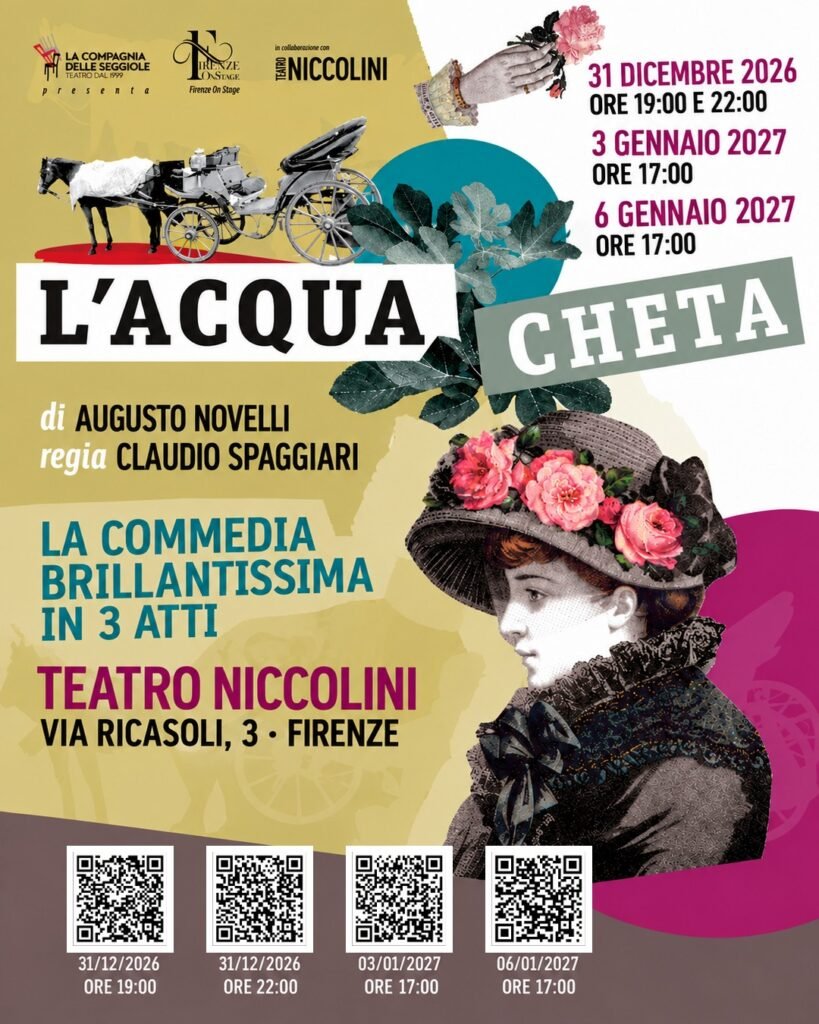
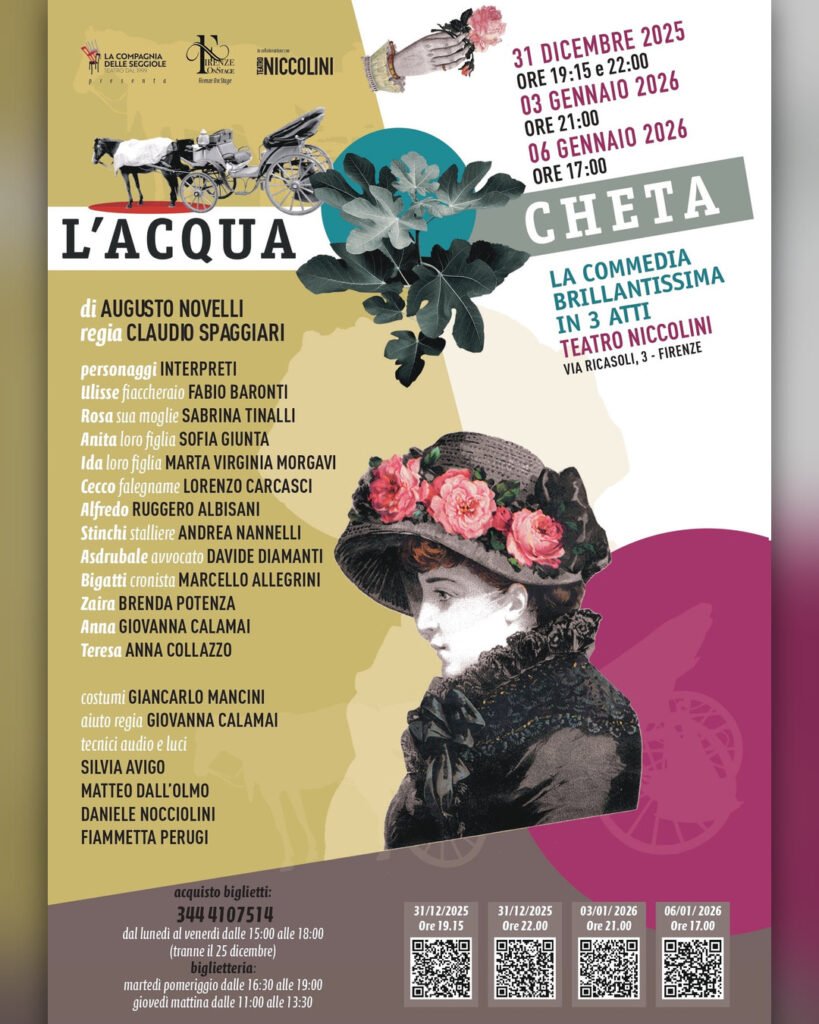
In Florence at the beginning of the twentieth century, Anita and Ida, the two daughters of Ulisse and Rosa, attract the attention of two very different young men: Cecco, a carpenter, and the mysterious Alfredo. As their parents try to keep the girls under control, secret courtships and jealousy set off a series of comic situations. Between songs sung beneath windows, domestic mishaps and misunderstandings, true love ultimately triumphs.
HISTORY
L’Acqua Cheta is considered the masterpiece of Augusto Novelli and of Florentine dialect theatre. It was first performed at the Teatro Alfieri in Florence in January 1908 and ran for 26 consecutive evenings, marking the beginning of a revival of Florentine dialect theatre, which until then had remained like a fire smouldering beneath the ashes. The centenary of its debut was celebrated in 2008.
L’Acqua Cheta is now well over a century old. On New Year’s Eve 1908, a banquet was being held at Teatro Alfieri in Florence in honour of the celebrated actor Andrea “Dreino” Niccòli, who was preparing to leave for America on tour with his company. Playwright Augusto Novelli, who happened to be passing by, was invited onto the stage to speak and managed to persuade the actor to try his luck with a new theatrical project: a comedy that would bring popular Florentine dialect theatre to America. Novelli promised to write one act before the company’s departure. The three-act comedy premiered on January 29 under the title L’Acqua Cheta. It was an overwhelming success.
Since then, the comedy has been performed countless times, both as a spoken play and as an operetta, with Giuseppe Pietri’s musical adaptation dating from 1920. Over the course of its stage history, the work has evolved considerably, with significant changes to its form, language and hierarchy of characters.
In keeping with Novelli’s intention to express his own idea of popular theatre, audiences and theatre companies have made the work their own over the years, adapting the text, scenes and characters with cuts and additions born from actors’ improvisation and audience response, effectively treating it as a product of oral culture. In theatrical practice today, there is no single “Acqua Cheta”, but rather many different versions. As with any work rooted in popular culture, we are faced on the one hand with a great number of variations and, on the other, with stage conventions so familiar and beloved by audiences that, although they are not “written”, changing or renewing them can be risky.
Seen in this light, this apparently light-hearted comedy reveals many different layers of meaning. Above all, however, it seems to represent for Florentines, and perhaps for non-Florentines too, that Florence, how beautiful it was…, that they once knew or heard stories about: the Florence that existed “before”. Before the tourists, before the flood, before the Great War… in any case, before some disaster that changed the face of the city.